DSCR Lenders: How to Compare Quotes and Pick One
Compare DSCR lenders without the sponsored lists. The nine terms to check on every quote, how broker, correspondent and direct pricing differ, and the red flags.
By the DSCRLoanCalculator.org team
DSCR lenders come in three kinds: direct lenders that fund with their own money, correspondent lenders that close in their own name and then sell the loan, and brokers that shop your file to a list of both. Knowing which one you are talking to tells you who sets your price and how much of that price can move.
Search for the best DSCR lenders and you mostly get paid placement. What those lists skip is the part that saves money: which terms to line up side by side, and which questions turn a quoted rate into a real one.
Direct lenders, correspondents and brokers: who prices your loan
| Type | Whose money | Whose rules | What you pay them |
|---|---|---|---|
| Direct lender | Its own, or a securitization | Its own credit box | Origination points and lender fees |
| Correspondent | A warehouse line, then sold to an investor | The investor’s guidelines | Origination plus a margin over the investor’s sheet |
| Broker | None | Whichever lender takes the file | A broker point, disclosed at closing |
A direct lender underwrites in house. Exceptions are possible because the person who can say yes works there. One set of rules, one set of fees.
A correspondent closes the loan in its own name, then sells it. It prices off an investor’s rate sheet and adds a margin, so the credit box belongs to someone else even though the logo on your note does not.
A DSCR loan broker does not lend at all. It submits your file to wholesale DSCR lenders, which do not take applications from the public, and gets paid out of the loan.
When a broker is worth the extra point
Clean file, single family, 25 percent down, strong score? Go direct and skip a layer of markup.
Anything needing an exception usually moves faster through a broker who runs 20 programs and knows which one takes a 660 score, a mid term rental or a non warrantable condo. Score sits at the center of both paths, so check the score bands lenders price off before you make the first call.
The nine terms to compare on every DSCR quote
Rate alone tells you almost nothing. Get these nine in writing from every lender:
- Interest rate, and whether it is locked or floating.
- Points and lender fees, in dollars rather than percentages.
- Prepayment penalty: structure, length and buyout cost.
- Maximum LTV at your actual score and property type.
- Minimum DSCR, and the exact formula behind it.
- Which rent counts: signed lease, appraiser’s market rent, or the lower of the two.
- Term and amortization: 30 year fixed, ARM, or an interest only period.
- Reserves: how many months, and whether they must be liquid.
- Third party costs: appraisal, rent schedule, title, legal and entity review.
Items five and six move the math more than the rate does. Two lenders quoting the same rate can land on different ratios if one folds HOA dues into the payment and the other leaves them out, which is why the DSCR formula is worth reading before you compare anything.
These are business purpose loans, so you usually will not get a Loan Estimate, the standard form that consumer borrowers use to compare offers. You build the comparison yourself.
How to read a rate sheet and spot the add ons
A wholesale rate sheet starts with a base rate in a grid: LTV across the top, credit score down the side. Then it stacks add ons, priced either in points or in rate.

The usual ones are cash out, short term rental income, two to four units, condos, loan amounts under roughly $150,000, a ratio below 1.00, and buying out the prepayment penalty. Each add on looks small on its own. Four of them stacked is not small.
Ask for the grid and the add on page, not just the number at the bottom of the email. What sets DSCR loan pricing covers the spread over conventional and where it comes from.
Worked example: same rent, two quotes
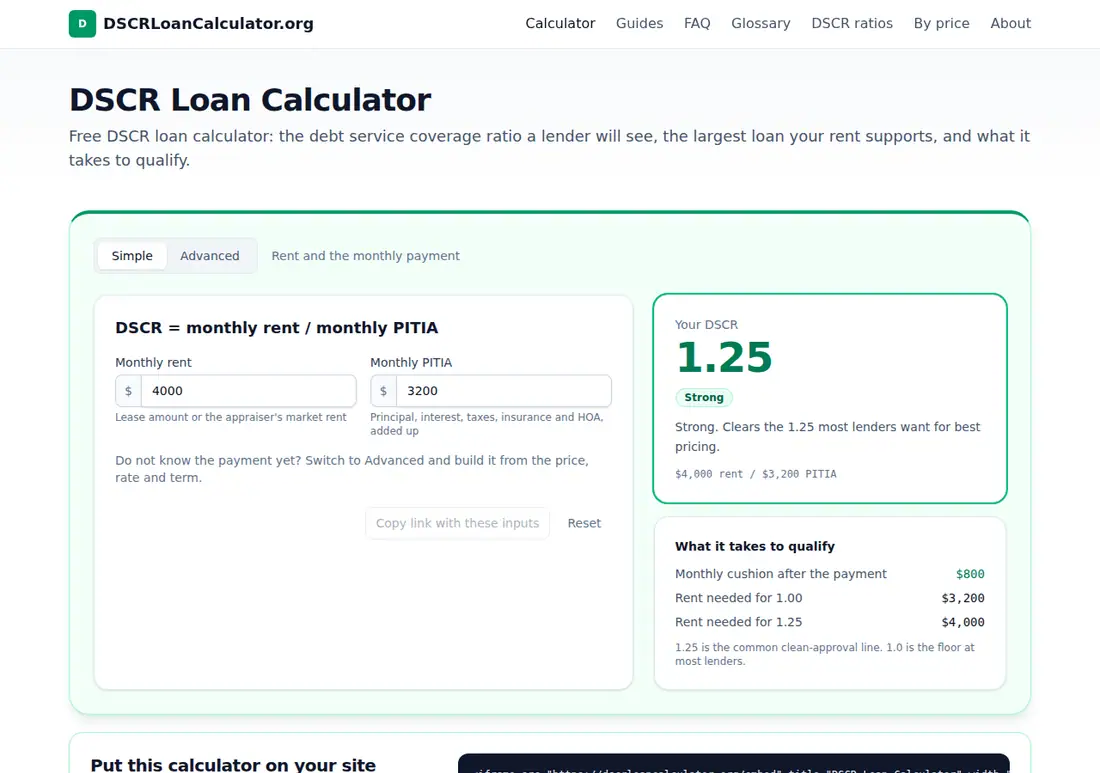
Take the standard deal on this site. A $500,000 rental renting for $4,000 a month, with $6,000 a year of property taxes and $2,500 of insurance.
One lender’s quote produces a $3,200 PITIA payment. That is $4,000 divided by $3,200, or a DSCR of 1.25. A second lender stacks two add ons and lands at $3,330, and the same rent now gives 1.20. Same house, same tenant, different pricing tier.
Questions that separate a real quote from a teaser
- Is this a rate sheet quote or a term sheet from underwriting?
- What score, LTV and ratio did you assume to get this rate?
- Is the rate locked, and for how many days?
- What is the prepay, and what does buying it out cost in points?
- Who orders the appraisal and rent schedule, and when do I pay for it?
- What could change this rate between today and closing?
A real quote names its assumptions. A teaser names one number and avoids the rest.
Prepay is where the gap usually shows. Read the prepayment penalty definition and ask for the structure by name, such as a five year step down or a three year flat fee. Term choice is the quieter lever, because an interest only period lowers the payment and lifts your ratio on paper, and loan term options explain what you trade for that.
Red flags when you shop DSCR loan companies
Upfront money beyond a disclosed appraisal deposit. No written term sheet after you hand over a complete scenario. Terms that drift in the final week with nothing new in the file.
An appraisal ordered before anyone shows you terms. A prepay described as standard with no structure attached. A rate that only holds if you skip the rent schedule.
Check the company before you send documents. Many DSCR lenders operate business purpose only, which in some states means no consumer license is required, but if a company is licensed it appears in NMLS Consumer Access. The entry on mortgage brokers is a plain explanation of how the wholesale relationship works.
How many lenders to shop, and in what order
Three or four quotes is plenty. Beyond that you are repeating yourself.
Start with one direct lender to set a floor. Add one broker to reach programs you cannot call yourself. Then go back to whichever came in stronger and ask it to beat the other.
Send all of them the same one page scenario on the same day. Different assumptions produce different rates, and that is exactly how a weaker quote ends up looking better than it is. Once you pick, the application steps run about the same at every lender.
Run your own numbers first
Price the deal before anyone prices it for you. Put your rent, taxes, insurance and expected payment into the DSCR Loan Calculator, and you will start the first call already knowing the ratio every quote is built on.

Frequently asked questions
What are DSCR lenders?
DSCR lenders are companies that qualify an investment property loan on the property's rent instead of your personal income. They fall into three groups: direct lenders using their own money, correspondent lenders that close in their own name and sell the loan, and brokers that submit your file to wholesale lenders. All three can fund the same deal at different prices.
Is a DSCR loan better through a broker or a direct lender?
It depends on your file. A clean single family purchase with a strong score and 25 percent down usually prices best direct, because you skip a layer of markup. A broker earns their fee on harder files: lower scores, short term rentals, non warrantable condos, foreign national borrowers, or small loan amounts that most programs decline.
How many DSCR lenders should I get quotes from?
Three or four is enough. Send every one of them the same scenario on the same day: purchase price, rent, taxes, insurance, HOA dues, credit score, entity, target LTV and whether the unit is occupied. Identical inputs are what makes the quotes comparable. Shopping more than four mostly repeats work and stretches out your timeline.
Do DSCR lenders charge upfront fees?
Most collect an appraisal deposit once you accept a term sheet, which is normal and disclosed. Application fees or commitment fees paid before you see written terms are a warning sign. Origination points, lender fees, title, legal and entity review costs all belong on the closing statement, not in a wire sent during the shopping stage.
What should I compare between two DSCR loan quotes?
Rate, points and lender fees in dollars, the prepayment penalty structure and buyout cost, maximum LTV at your actual score, the minimum DSCR and the formula behind it, which rent figure counts, term and amortization type, required reserves, and third party costs. The rate alone hides most of the difference between two offers.