How to Apply for a DSCR Loan: Pre-Approval, Documents, Closing
How to apply for a DSCR loan in five steps: the term sheet and soft credit pull, the documents needed, the appraisal and rent schedule, underwriting and funding.
By the DSCRLoanCalculator.org team
How to apply for a DSCR loan comes down to five steps: get a term sheet, send the documents, let the appraiser set the value and the rent, clear underwriting conditions, then sign and fund. Nothing in that sequence asks for a pay stub. The documentation requirements are far shorter than a W-2 mortgage, and that is the whole point of the product.
Three to five weeks from application to funding is the normal range, and a quick close inside three weeks happens when the file is complete on day one. What lenders check and what they skip is covered in the guide on DSCR loan requirements. This page is the order of events and the document list.
What a rental loan file looks like next to a W-2 loan
A primary residence loan is built around you. Tax returns, W-2s, pay stubs, a debt-to-income calculation, letters explaining deposits. A DSCR file is built around the property. The underwriter wants to know what the unit rents for, what the full payment will be, how much you are putting down, and how much cash you have left after closing.
That swap changes the shape of the file. There is less paper, but each piece carries more weight. One wrong figure on an insurance quote moves the ratio, and the ratio sets the pricing. Self-employed investors who dread income docs usually find this version easier, which is most of the answer to whether these loans are hard to qualify for.
Step 1: term sheet and soft credit pull
DSCR loan pre-approval does not work like agency pre-approval. No underwriter reads your income. You hand over a property address, the contract price or estimated value, the rent, the annual taxes, the insurance figure, any HOA dues, your credit score range and your entity plan. The lender comes back with a term sheet: loan amount, rate, points, prepayment structure, reserve requirement and the DSCR they used to price it.
Most lenders quote from a soft pull or a self-reported score and run the tri-merge report later. A soft pull leaves your score alone, so the question of whether a DSCR loan affects your credit mostly turns on when the hard pull lands.
Read a term sheet as a quote, not an approval. Compare two or three of them before you pay an appraisal fee, because that fee is the first real money you spend.
Step 2: the documents you send in
This is the DSCR loan documents needed list at most lenders.
Borrower side:
- Photo ID and Social Security number for each guarantor.
- Two months of bank or brokerage statements, every page, showing the down payment and the reserves. Underwriters are looking at liquidity, so avoid funds that arrived last week with no paper trail.
- A credit authorization form.
- A signed loan application and a business purpose affidavit confirming you will not occupy the property.
Property side:
- The purchase contract with all addenda, or a current mortgage statement and payoff on a refinance.
- The lease, plus proof of the last one to three months of rent deposits, if the unit is occupied.
- An insurance quote or binder with the lender listed as mortgagee.
- HOA contact and dues, and a rent roll on a two to four unit property.
Entity side, if you are closing in a company: articles of organization, operating agreement, EIN letter and a certificate of good standing. Closing in an LLC is routine, but mismatched names between the contract, the entity and the title commitment are a classic source of delay.
Send it all in one batch as clearly named PDFs. Files that trickle in get worked on in pieces.
Step 3: appraisal and the rent schedule
The lender orders the appraisal once you pay the fee. On a single family rental the order should include Form 1007, the comparable rent schedule, which reports a market rent. Two to four units get Form 1025 instead. Most lenders then use the lower of your lease rent and that market rent.

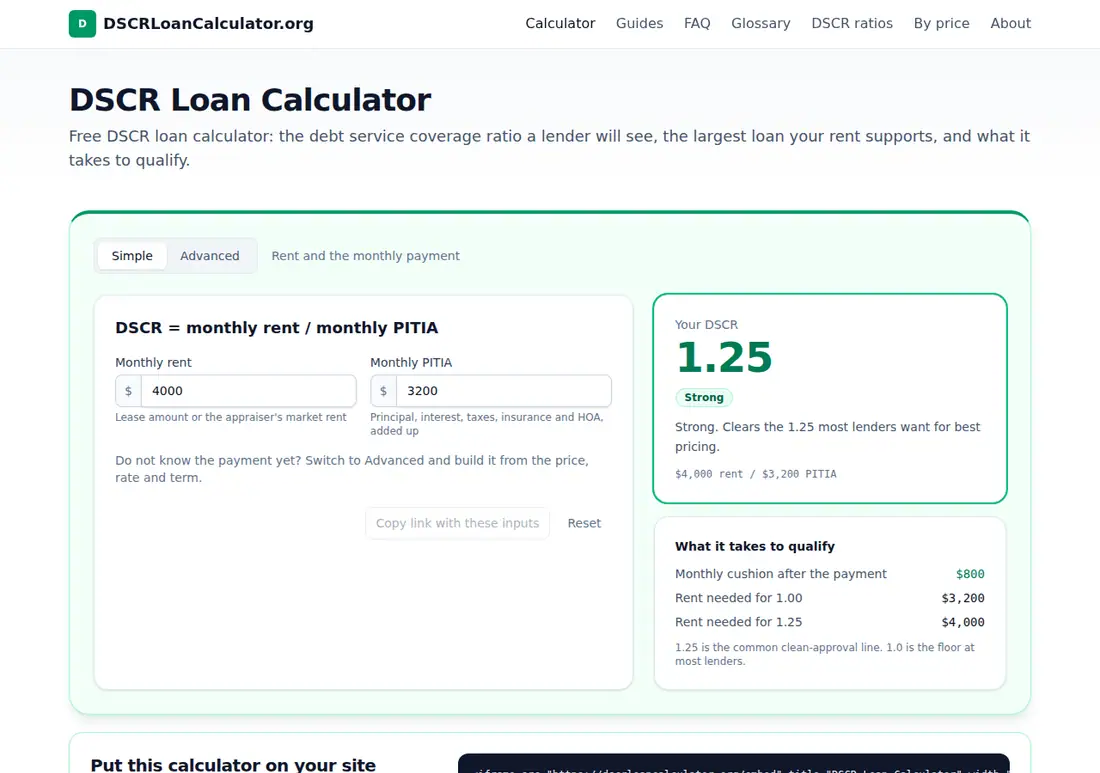
Take the standard example on this site: a $500,000 rental renting for $4,000 a month, with $6,000 a year of property taxes and $2,500 of insurance. Those two items add about $708 a month. On the default loan the full PITIA lands near $3,333, which puts the DSCR around 1.20. In the simple tab, $4,000 of rent against a $3,200 PITIA payment gives 1.25.
Now say the rent schedule reports $3,700 of market rent rather than the $4,000 lease. The payment has not moved, but $3,700 divided by $3,333 is about 1.11. Same house, lower tier, higher rate.
Step 4: underwriting conditions that stall files
Conditions are normal. Every file gets them. The usual ones:
- Insurance higher than quoted. If the binder comes back at $5,000 a year instead of $2,500, the payment rises about $208 to roughly $3,541, and the ratio slips from 1.20 to about 1.13.
- Sourcing a large deposit in your bank statements.
- Proof of rent deposits when the lease rent looks above market.
- Entity documents that do not match the vesting on the contract.
- Appraisal repairs, or a reinspection on work in progress.
- Title problems: an old lien, a judgment, an estate in the chain.
- Reserves that fall short once closing costs are counted.
None of that is an income document. Each item is a fact somebody has to verify, and each one moves faster when you answer in hours instead of days.
Step 5: closing and funding
After the last condition clears you get a clear to close, then the settlement statement with final numbers. Business purpose loans sit outside the consumer mortgage disclosure rules, so there is usually no mandatory waiting period between final figures and signing. You sign with a notary, the entity signs a resolution authorizing the loan, and the lender wires funds for recording.
Verify wire instructions by calling the title company at a number you looked up yourself. Never trust instructions that arrive by email alone.
How to close in under three weeks
Speed comes from preparation, not pressure. Form the entity and collect its documents before you apply. Request the insurance quote the day you go under contract. Pay the appraisal fee the same day it is requested, and ask whether a rush order is available in that market. Keep the down payment and reserves in one account for at least sixty days. Answer every condition the day it arrives.
The appraisal is the step you control least, so typical approval timelines mostly reflect appraiser availability, which varies by market and season.
Check the ratio before you apply
Before you ask for a term sheet, run the deal through the DSCR Loan Calculator on the home page. Enter the price, the rent, the taxes and the insurance, and you will see the ratio a lender will price from, plus how much a rent haircut or a higher insurance premium would cost you.

Frequently asked questions
How do I apply for a DSCR loan?
Start with a term sheet. Give the lender the property address, the price or estimated value, the rent, the taxes, the insurance and any HOA dues, plus your credit score range. If the terms work, you send a short document package, the lender orders the appraisal and rent schedule, underwriting issues conditions, and you sign. Three to five weeks is typical.
What documents are needed for a DSCR loan?
Photo ID, two months of bank statements covering the down payment and reserves, a credit authorization, a signed application and a business purpose affidavit. On the property side: the purchase contract or a payoff statement, the lease and recent rent deposits, an insurance quote, and HOA details. Borrowing through an LLC adds the articles, the operating agreement and the EIN letter.
Is DSCR loan pre-approval a hard credit pull?
Often not at the start. Many lenders quote from a soft pull or a self-reported score, then run a tri-merge report once you move forward and use the middle score. The hard pull is one inquiry and its effect is small and short lived. Ask each lender when that pull happens so you are not stacking several in a row.
What do DSCR loan underwriting guidelines check?
Four things carry the file: rent against the full PITIA payment, your credit score, your down payment or LTV, and cash reserves left after closing. Underwriting also verifies the entity, title, insurance, the lease and the appraiser's market rent. There is no debt-to-income calculation and no tax returns, so conditions tend to be property and paperwork questions.
How fast can a DSCR loan close?
A quick close inside three weeks is realistic when the appraisal goes out on day one, the entity documents already exist, the insurance quote is in hand and every condition gets answered the same day. The appraisal is the longest fixed step, often one to two weeks. Rural property and busy seasons stretch that out.