DSCR Loan Rates: What Sets Your Price and the Spread Over Conventional
DSCR loan rates run above conventional investment loans. See what builds the quote: index, spread, credit score, LTV, cash-out, prepay, and points.
By the DSCRLoanCalculator.org team
DSCR loan rates are higher than conventional loan rates. That is the plain answer to the question most readers arrive with. A DSCR loan is underwritten on the rent the property collects instead of your tax returns, and it is funded by private investors rather than Fannie Mae or Freddie Mac, so the money costs more. No honest page can post DSCR loan interest rates today, because each lender prices off its own sheet and that sheet moves with the bond market. What a page can do is show you how a quote gets built, so the number you are handed makes sense.

Where a DSCR rate starts: index plus spread
Every quote has two parts. The first is a market index. A 30 year fixed DSCR loan takes its cue from longer term bond yields and from what investors are paying for pools of non-agency rental loans. An adjustable version is tied to a published index, usually SOFR, plus a margin written into the note.
The second part is the lender’s spread, which covers cost of funds, servicing, default risk and profit. Index plus spread gives a base rate, the rate before anything about your file is considered. Then the adjusters start, and that is where your interest rate becomes yours rather than the market’s.
The spread over a conventional investment loan
There are two questions here. Why is there a gap, and how big is it.
The gap exists because these are not the same product. A conventional investment loan follows agency rules, documents your personal income, and can be sold to Fannie or Freddie at a known price. A DSCR loan skips the income documentation, allows an LLC on title, and gets sold into private securitizations where buyers want a higher yield. That extra yield is your rate.
How big the gap runs depends on the market, so treat any fixed figure with suspicion. Most of the time a DSCR rate for a strong file lands somewhere between roughly half a point and two points above the conventional investment rate the same borrower could get. The range is wide because the adjusters below do the work. A high score with 25% down sits near the bottom of it. A 680 score with 20% down and cash out sits near the top. For the full comparison on qualifying and paperwork, read how a DSCR loan stacks up against a conventional loan.
The adjustments that build your quote
Rate sheets quote these in basis points. One hundred basis points is one percent of rate, and a typical adjuster is 12.5 to 50 basis points. Stack four of them and you have moved a point.
Credit score
Usually the largest lever after LTV. Tiers tend to step every 20 points, with the best pricing reserved for the top band. Dropping one tier costs real money, and the penalty grows as you approach the program floor.
Loan to value
Less borrowed prices better. Tiers commonly sit at 65%, 70%, 75% and 80%. Crossing one tier can save more than 20 points of credit score, which is why a slightly larger down payment sometimes pays for itself.
Property type
A single family house is the baseline. Condos, two to four unit buildings, rural properties and short term rentals usually carry an add-on, because resale and rent data are thinner.
Purchase or cash-out refinance
Cash-out prices above a purchase or a rate and term refinance. Pulling equity out raises the lender’s exposure, and the adjuster reflects that.
Prepayment structure
A five year step-down prepay usually earns the best price. Shortening it, or buying it out entirely, raises the rate. Read the prepayment penalty options before you trade rate for flexibility you may never use.
How the ratio itself prices the loan
Many lenders also price by DSCR tier. A ratio of 1.25 or better gets the cleanest terms, 1.00 to 1.10 picks up an add-on, and anything under 1.00 moves to a separate program with a higher rate and a lower maximum LTV. So the rate sets the payment, the payment sets the ratio, and the ratio sets the tier the rate came from. It is a loop, and it is why small changes land hard.
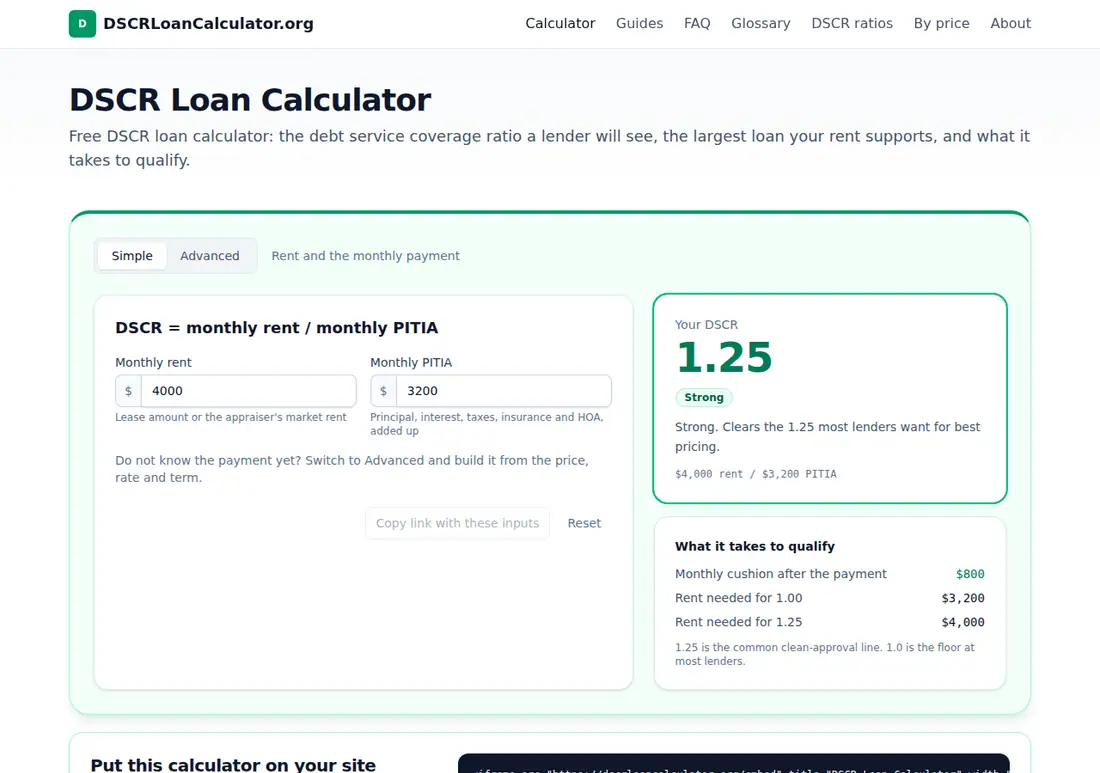
Use the default property. A $500,000 rental renting for $4,000 a month, with $6,000 of property taxes and $2,500 of insurance, carries about $708 a month of taxes and insurance. Put 20% down and a $400,000 loan at 7.00% on a 30 year fixed has a principal and interest payment near $2,661, so PITIA is about $3,370 and DSCR is about 1.19. Put 25% down instead and the loan falls to $375,000, PITIA lands near $3,200, and the ratio reaches 1.25, the same figure the simple tab returns on $4,000 of rent against a $3,200 payment.
Buying the rate down with points
Discount points are prepaid interest. One point on that $400,000 loan is $4,000. Say it buys a quarter point, taking 7.00% down to 6.75%. The payment drops about $67, PITIA goes to roughly $3,300, and the ratio moves from 1.19 to 1.21. Break even on the $4,000 takes about five years of holding. That trade works if you plan to keep the property and the quarter point clears a ratio minimum. It looks thin if you expect to sell or refinance in three years.
Reading two quotes that look the same
Two quotes at 7.25% are often two different loans. Check the lender fees and the annual percentage rate, whether the loan is interest-only or fully amortizing, how long the prepay runs, how long the rate is locked, and whether the quoted payment includes taxes, insurance and HOA dues.
Interest-only quotes flatter the ratio most of all. On the same $400,000 loan at 7.00%, an interest-only payment is $2,333, PITIA is about $3,042, and the ratio reads 1.31 with no change in rate. Nothing goes toward principal while that lasts.
What a half point does to your ratio
Same default property, same $400,000 loan, same 30 year fixed term. Only the rate moves.

- 6.50%: payment about $2,528, PITIA about $3,237, DSCR about 1.24
- 7.00%: payment about $2,661, PITIA about $3,370, DSCR about 1.19
- 7.50%: payment about $2,797, PITIA about $3,505, DSCR about 1.14
Half a point of rate costs roughly five hundredths of ratio on this file, and about $136 a month of cash flow. That is the difference between a file that clears a 1.20 minimum and one that does not, which is why rate shopping on a rental is not the same chore as rate shopping on a house you live in.
Check a quote against your own numbers
Before you accept a rate, see what it does to the ratio. Put the quoted rate, the loan amount and the prepay terms into the DSCR Loan Calculator on the home page, then run the next quote beside it. The one with the better ratio is usually the one worth signing.
Frequently asked questions
Do DSCR loans have higher interest rates?
Yes, almost always. A DSCR loan is underwritten on the property's rent instead of your tax returns, and it is sold to private investors rather than Fannie Mae or Freddie Mac, so it prices higher than a conventional investment loan. The size of the gap moves with credit score, LTV and prepay terms. Expect a real premium, not a rounding difference.
What are DSCR loan rates today?
No page can quote a live number honestly, including this one. DSCR pricing shifts with bond markets, and every lender runs its own rate sheet with its own adjusters. Get two or three written quotes on the same day, for the same loan amount, LTV and prepayment structure, then compare them line by line. Anything older than a week is stale.
Are DSCR loan rates fixed for 30 years?
They can be. A 30 year fixed is the most common DSCR structure, and the rate stays put for the full term. Lenders also offer interest-only periods, 5 and 7 year adjustable loans, and 40 year terms that start interest-only. A fixed rate usually costs more than an adjustable loan's opening rate, and it keeps your ratio predictable.
How much does the rate change my DSCR?
More than most borrowers expect. On the default $500,000 rental renting for $4,000 a month with a $400,000 loan, moving from 7.00% to 7.50% raises the payment by about $136 and drops the ratio from roughly 1.19 to 1.14. Half a point of rate costs about five hundredths of DSCR, which can decide an approval.
How do I get the best DSCR loan rates?
Shop lenders, then shop the adjusters. The same file often prices differently at three lenders because each one weights credit score, LTV, property type and prepayment terms its own way. Put down enough to clear an LTV tier, accept a longer prepay if you plan to hold, and ask what one point actually buys before paying for it.