DSCR vs DTI: Why a Rental Loan Can Ignore Your Paycheck
DSCR vs DTI explained: DTI tests your paycheck and personal debts, DSCR tests the rent against the payment. See which ratio decides your rental loan.
By the DSCRLoanCalculator.org team
DSCR vs DTI comes down to which income the lender measures. DTI, short for debt to income, compares your personal debt payments to your personal income. DSCR, short for debt service coverage ratio, compares the rent a property collects to the loan payment on that same property. One test grades you. The other grades the house.

That is why a rental loan can ignore your paycheck. The lender is underwriting the lease, the taxes and the insurance on one address.
Two ratios, two different questions
DTI asks whether you can carry one more payment on top of everything you already owe.
DSCR asks whether the property pays for itself.
| Question | DTI | DSCR |
|---|---|---|
| Income counted | your wages, self employment, bonuses | the property’s rent |
| Debts counted | every payment on your credit report | the PITIA on this property |
| Good result | lower, often 43% or less | higher, often 1.15 to 1.25 or more |
| Main paperwork | tax returns, W-2s, pay stubs | a lease or the appraiser’s market rent |
| Scope | all of your finances | one address |
The direction flips between them. On DTI a smaller number helps you. On DSCR you want the number above 1.00, because that is the point where rent covers the payment.
How debt to income gets built on an investor file
A lender adds up your required monthly payments, including the new mortgage, then divides by your gross monthly income. The result is your debt to income ratio. The 43% figure that gets quoted so often comes from the consumer mortgage rules, and the CFPB explains where it applies.
Investor files strain under that math. Every property you own adds a full payment the month you close. The rent that offsets it usually counts at a discount, often around 75% of gross rent, and many programs want the property on a filed Schedule E before they count it at all.
So the fifth rental can be the one that breaks the ratio even when all five cash flow. Nothing is wrong with the properties. The formula just loads debt faster than it credits income.
How the coverage test replaces it
The coverage test throws out your personal income and divides rent by the property payment.
Take the standard example on this site. A $500,000 rental renting for $4,000 a month, with $6,000 a year in property taxes and $2,500 a year in insurance, lands at a DSCR of about 1.20 on the default loan. The payment in the bottom of that ratio is PITIA: principal, interest, taxes, insurance and any HOA dues.
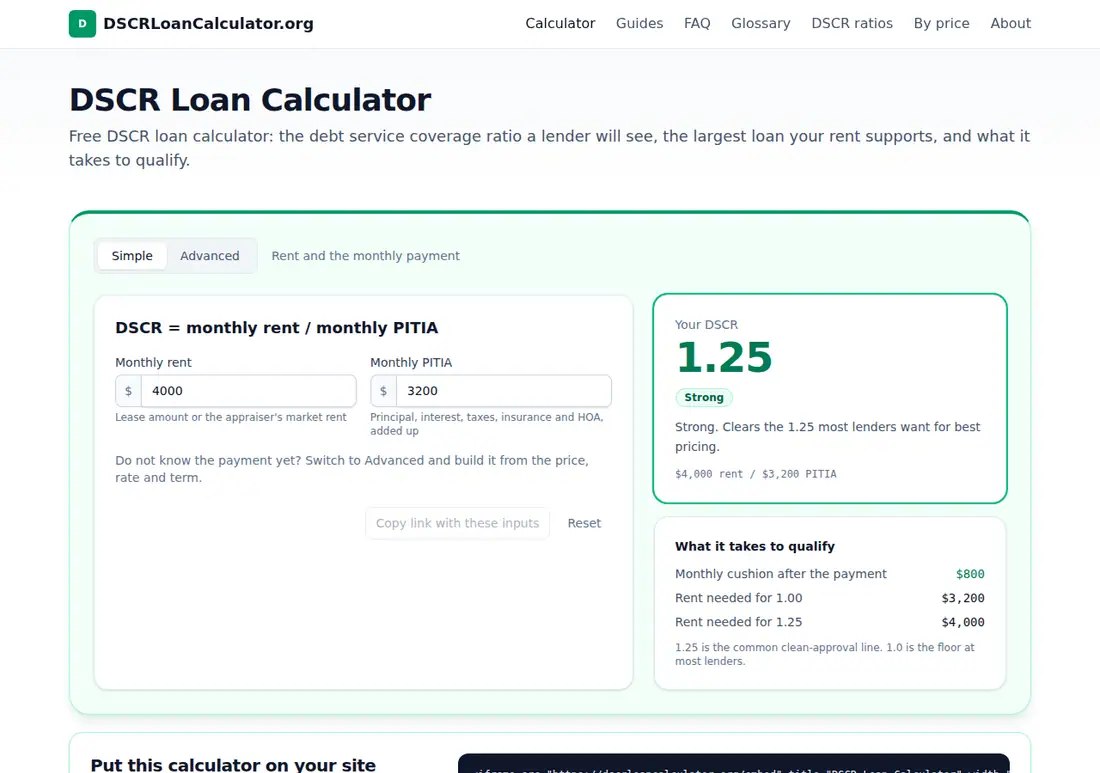
The simple version is easier to hold in your head. Rent of $4,000 against a $3,200 payment is a DSCR of 1.25. The property produces 25% more than it needs.
Business purpose investment loans sit outside the consumer ability to repay rules, which is what lets a lender skip your income documents. Debt service coverage is the same idea commercial lenders have used for decades, next to cousins like interest coverage and cash flow measured against total debt. Rental underwriting borrowed the tool and pointed it at a single house.
The borrower each ratio favors
DTI rewards a salaried borrower with a long job history, few debts and one or two properties.
The coverage test rewards a different profile: self employed owners who write off a lot, retired investors living on assets, people paid on commission, and anyone whose portfolio has outgrown a conventional file. Their tax return looks thin. Their rent roll does not.
That flexibility is not free. Comparing a DSCR loan with a conventional investment property loan shows where the trade sits, because the coverage route usually costs more in rate and in down payment.
DSCR and LTV: the second number that decides the deal
DSCR and LTV get checked together, and they pull on each other. DSCR measures income against the payment. Loan to value measures the loan against appraised value, and it sets your down payment.
Borrow less and the payment drops, so coverage rises. That is the lever most investors reach for when a file comes in under the minimum. On the $500,000 example, moving from 20% down to 25% down cuts the loan by $25,000 and lifts the ratio, because rent stays at $4,000 while the payment shrinks.
Rates and program minimums move with the market and with your credit, so treat any specific pricing as a quote rather than a rule. Most programs publish a floor somewhere between 1.00 and 1.25.
When your own debts still matter here
Skipping DTI is not the same as skipping you.
The lender still pulls your credit report and prices the loan off your score. Most ask for reserves, usually a few months of payments sitting in the bank. Most want a personal guarantee even when the loan closes in an LLC. Late mortgage payments, a recent foreclosure or a thin credit file can sink a deal that clears the coverage test easily.
What drops out is the arithmetic. Your student loan, your car payment and your own home’s mortgage do not get stacked into a ratio against your salary.
Reading both numbers before you shop
- Work out your DTI with the new payment included. If it clears, a conventional loan is usually cheaper.
- Work out the coverage ratio on the property using the lease rent, or market rent if the unit is vacant.
- Ask each lender for its minimum ratio and whether it uses actual rent or appraised market rent.
- If the ratio falls short, test a larger down payment before you test a different property.
Two numbers, two answers. A turndown on debt to income tells you nothing about whether the rental qualifies on its own.
Run it on the DSCR Loan Calculator
Enter the price, rent, taxes and insurance in the DSCR Loan Calculator on the home page and it returns the ratio along with the payment behind it. Change the down payment or the rate and watch the coverage number move before you talk to a lender.
Frequently asked questions
What is the difference between DSCR and DTI?
DTI compares your personal debt payments to your personal income, so it grades you. DSCR compares a property's rent to the loan payment on that property, so it grades the house. DTI counts every debt on your credit report. DSCR counts only the principal, interest, taxes, insurance and HOA dues on one address.
Do DSCR lenders look at debt to income at all?
Most do not calculate it. They skip tax returns, W-2s and pay stubs, so your salary, car loan and student loan never enter a ratio. They still pull your credit report, set the rate from your score, ask for reserves in the bank, and usually want a personal guarantee even when the loan closes in an LLC.
Can I get a rental loan after being turned down for high DTI?
Often yes. A turndown on debt to income says nothing about whether the property covers its own payment. If the rent clears the lender's minimum coverage ratio and your credit and reserves hold up, the file can pass. Expect a higher rate and a larger down payment than a conventional investment loan.
How do DSCR and LTV work together?
Both have to pass. DSCR measures rent against the payment. LTV measures the loan against appraised value and sets your down payment. They pull on each other: borrowing less shrinks the payment, so the coverage ratio rises. Raising your down payment is the usual fix when a ratio lands just under the minimum.
Which ratio is better for an investor with several rentals?
Neither is better in the abstract. Conventional loans priced on debt to income are usually cheaper, so test that first. The coverage test tends to win once a portfolio grows, because each new property adds a full payment to DTI right away while the rent is credited at a discount and often only after it appears on a filed Schedule E.