DSCR Loans for Airbnb: How Lenders Count Short-Term Rental Income
Getting a DSCR loan for Airbnb? Lenders count either long-term market rent or nightly revenue after a haircut. See which applies and how to prove it.
By the DSCRLoanCalculator.org team
A DSCR loan for Airbnb income runs on the same math as every other DSCR loan, except for the one thing that decides deals: whether the lender counts your nightly revenue or only long-term market rent. On a leased house the lender uses the signed lease or the appraiser’s market rent. For a nightly rental the lender first decides whether to count nightly revenue at all, then how much of it to count. That choice moves your DSCR further than the interest rate does.
The short answer is that three policies exist. Some programs ignore nightly income and underwrite the property at long-term market rent. Some count documented nightly revenue after an expense deduction. A few will not lend on nightly use. Find out which one you are dealing with before you pay for an appraisal.
Market rent or nightly revenue: which figure the lender uses
Lenders land in one of three places, and the policy is set at the program level, not negotiated file by file:
- Long-term market rent only. The appraiser’s rent schedule figure goes in the ratio and your booking income is ignored. This is the most common approach, and it is the one to assume until a lender tells you otherwise.
- Documented nightly revenue minus an expense factor. Your actual operating income counts, reduced to cover vacancy, cleaning, platform fees, utilities and management.
- The lower of the two. Common with lenders who allow nightly use but do not want to bet on it.
Here is what that looks like with the site’s standard example. A $500,000 rental with $4,000 a month of market rent, $6,000 a year of property taxes and $2,500 of insurance carries a PITIA of about $3,330 and a DSCR of about 1.20 on the default loan. Now say the house grosses $6,000 a month as a short-term rental. Under a market rent program your ratio is still 1.20, and the extra $2,000 does nothing for your file. Under a program that counts nightly revenue with a 25 percent expense deduction, income becomes $4,500 and the ratio rises to about 1.35. Same house, same debt, two different approvals. The guide to what counts in the ratio walks through the income and expense lines in more detail.
Booking statements, data reports and 12 months of history
Lenders that count nightly income want twelve months of it for the subject property. The usual proof is platform earnings statements or transaction history, a property manager’s owner statements, or both. Many also ask for bank statements showing the deposits, and a tax return or 1099 if the property has been operating long enough to appear on one.
Two details cause friction. First, gross revenue and your net payout are different numbers, because platform fees, cleaning collected and taxes remitted sit between them. Ask which line the underwriter uses. Second, a partial year is not always acceptable. Some lenders annualize eight or nine months of statements, others require a full twelve so a slow season is included. Nobody credible annualizes a peak quarter.
A third-party short-term rental data report can support a projection, and some programs accept one at reduced weight when the property is new to nightly use. It rarely carries the same value as your own statements.
The haircut lenders apply to seasonal income
Expect gross nightly revenue to be cut before it reaches the ratio. The deduction typically runs about 20 to 30 percent, depending on the program and the market, and it reflects real costs a lease does not carry: turnover cleaning, higher utilities, furnishing replacement, platform commission and professional management that often runs 20 percent or more of revenue in resort markets.
Run both ends on the example above. At a 20 percent deduction, $6,000 of gross revenue becomes $4,800 and the ratio is about 1.44. At 30 percent it becomes $4,200 and the ratio is about 1.26. Both clear a 1.20 threshold, so the haircut is survivable here. On a thinner deal it is the difference between approval and decline, which is why the exact percentage belongs in your term sheet conversation.
Rate and down payment add-ons for nightly use
Most lenders treat nightly income as less durable than a lease, and they price for it. Some add a fraction of a point to the rate, some cap the loan-to-value a few points below their long-term rental maximum, and some do both. Sizes vary by lender and property type, so get the add-on quoted in writing alongside the base pricing on DSCR loan rates.
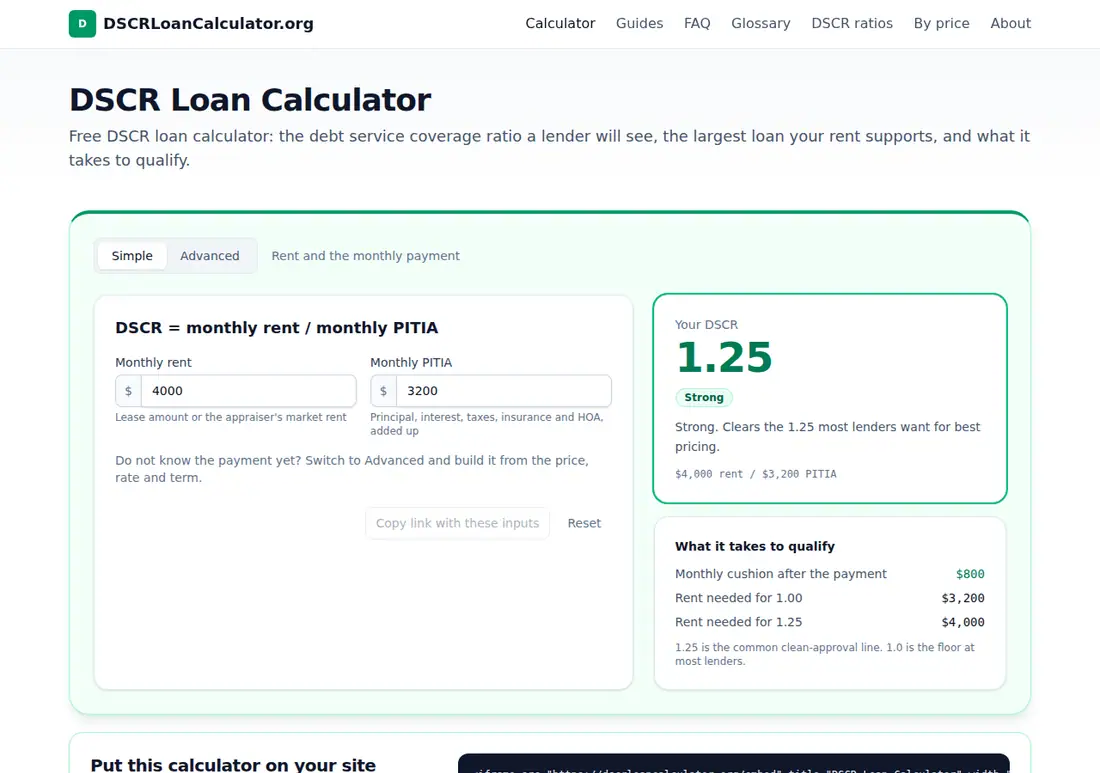
The add-on has a predictable effect. If a higher rate pushes PITIA from $3,330 up to $3,500, then $4,000 of market rent gives a ratio of about 1.14 instead of 1.20. On the nightly figure of $4,500, the same payment still produces about 1.29. A smaller payment works the other way: $4,000 of rent against a $3,200 payment is a DSCR of 1.25.
Local rules that can sink the file
Underwriting checks whether nightly use is even legal at the address. Permit caps, registration requirements, minimum stay rules and primary residence conditions all show up in city code, and condominium bylaws or HOA rules often ban stays under 30 days outright. If nightly use is restricted, the lender underwrites long-term rent at best.
Heavy hotel style operation can also push the property out of the residential box. A building running like lodging, with a front desk or commercial zoning, may be treated as commercial property and routed to a commercial mortgage with different terms and a different appraisal.
Running the numbers when the property has no history
With no operating history, qualify the deal on long-term rent. If it does not clear the lender’s minimum on the appraiser’s market rent, the purchase depends entirely on one program’s willingness to credit a projection, and that policy can change between your offer and your closing.
The safer path is to buy on the lease number and treat nightly upside as upside. Operate for twelve months, build the statements, then look at refinancing into better terms with documented income. A cash-out refinance at that point gets underwritten on the same haircut nightly revenue, so the history you build is worth real money later.
Check your own numbers
Run both income figures through the DSCR Loan Calculator on the home page. Enter the appraiser’s market rent first to see the floor, then enter your nightly revenue after the expense deduction to see the ceiling. If both clear your lender’s minimum, the policy question stops mattering.

Frequently asked questions
Can you get a DSCR loan for a short-term rental?
Usually yes. Many DSCR programs finance short-term rentals, including furnished nightly rentals. The qualifying income is the catch. Some lenders underwrite the property at long-term market rent and ignore your nightly revenue entirely. Others count documented nightly income after an expense deduction. A few decline nightly use outright, so confirm the program allows it before you order an appraisal.
Do DSCR lenders count Airbnb income?
Some do, some do not. Lenders that count it want proof: twelve months of platform or property manager statements for the subject property, sometimes backed by tax returns or bank deposits. They then subtract an expense factor to reach a net figure. Lenders that do not count it fall back on the appraiser's long-term market rent, which is often lower than gross nightly revenue.
What DSCR do lenders want on a short-term rental?
The same thresholds as any DSCR loan, commonly 1.00 to 1.25 for the best pricing, with some programs going below 1.00 at a cost. Nightly use does not usually change the target ratio. It changes the income that gets you there, because the lender may haircut gross revenue or use market rent instead.
Can I get a DSCR loan on an Airbnb with no rental history?
Often yes, but on long-term rent. With no operating history for the property, most lenders use the appraiser's market rent, and some will consider a third-party short-term rental data report at reduced weight. Run the deal at the long-term number first. If it only works on projected nightly revenue, you are depending on one lender's policy holding.
Are DSCR rates higher for short-term rentals?
Often slightly, and leverage is usually a little lower. Lenders see nightly income as more seasonal and more management dependent than a signed lease, so many price short-term rentals above comparable long-term rentals or cap the loan-to-value a few points lower. The size of the add-on varies by lender and market, so ask for it in writing with the rate quote.