DSCR Loan With Bad Credit: Score Tiers, Pricing and Low-Score Options
A DSCR loan with bad credit usually means a 620 floor, with pricing steps at 660, 700, 720 and 740. What a low score costs in rate, LTV and reserves.
By the DSCRLoanCalculator.org team
A DSCR loan with bad credit is still doable, but 620 is the common floor: most programs stop there, some at 640 or 660, and a few reach down to 600. Your credit score does two things on a DSCR loan. It decides whether a lender will take the file, and it sets the price once they do. So a DSCR loan with a 580 credit score is hard to find as a 30 year loan, and a DSCR loan with no minimum credit score usually means one specific situation rather than no credit test at all. Both get their own section below.

The score sits next to the rent ratio, the down payment and the reserves. Those four, plus the property, are the file. What lenders check and what they skip walks through all of it. This page takes the score on its own, because one number on a rate sheet moves three other numbers in your deal.
The credit tiers lenders price off
Lenders pull a tri merge report from all three bureaus and use the middle score. On a loan closing in an entity, they pull the guarantor’s credit rather than the company’s. Your credit score then lands in a band on the lender’s matrix, and the bands are usually 20 points wide: 620 to 659, 660 to 679, 680 to 699, 700 to 719, 720 to 739, and 740 and up.
Two things are worth knowing about those bands. They are not standard, because DSCR loans are non-agency products and each lender writes its own grid, so the same 683 can price two ways on the same day. And the score is only part of the credit review. Recent mortgage lates, a bankruptcy in the last two to four years, or a foreclosure in the last three to seven years are separate gates. A clean 660 file often beats a 750 with a 60 day mortgage late behind it.
What happens between 740 and 660
Moving down the grid one band at a time, three things change. Rate goes up in small steps, usually a quarter point or less per band and more as you approach the floor. Maximum loan to value comes down. Reserves go up.
The top of the LTV menu is where the score bites first. An 80% purchase tier is commonly held for borrowers at 720 or higher with a ratio of 1.25 or better. Drop into the 660s and 75% is often the ceiling, with the same property and the same rent. For the detail on one score, a 680 credit score has its own page.
Take the standard example: a $500,000 rental renting for $4,000 a month, with $6,000 a year of property taxes and $2,500 of insurance. At 75% LTV the loan is $375,000, PITIA lands near $3,330 a month, and the ratio is about 1.20. Now say a lower band costs you three quarters of a point. The same $375,000 loan carries a payment near $3,525 all in, and the ratio falls to about 1.13. Nothing about the house changed. The rate sheet did.
Below 660: who still lends and at what cost
Plenty of lenders quote the 620 to 659 band. The terms tighten in a predictable pattern: LTV capped around 70 to 75%, reserves at the top of the range instead of the bottom, cash out limited or unavailable at the higher LTVs, and sometimes a higher minimum ratio of 1.10 or 1.25 rather than 1.00. Underwriting also asks for more, like letters of explanation on collections and proof that old judgments are satisfied.
Below 620 the 30 year DSCR market mostly closes. What stays open is short term: bridge and hard money financing, often 12 to 24 months, with points up front and a plan to refinance once the score recovers. That is a reasonable path for a flip. It is an expensive way to hold a rental for ten years. The minimums on these loans covers the other floors, including loan size.
A thin file is not the same as bad credit
Two borrowers can both show a 640. One got there through late payments and a charge off. The other has two young accounts and nothing negative at all. Underwriting treats them differently, and the thin file is usually the easier problem to solve.
Most lenders want a minimum number of open tradelines with some history behind them, often around three accounts seasoned a couple of years, and a mortgage or auto loan counts. If you are short, time fixes it: a secured card, a small installment loan, or being added as an authorized user on a seasoned account.
The real no minimum credit score case is a borrower with no US credit file, usually a foreign national. Those programs lean on foreign bureau reports, bank reference letters and a larger down payment instead of a score.
How a lower score moves down payment and LTV
A band change reads like a rate story and settles as a cash story. On the same $500,000 purchase, 80% LTV means $100,000 down, 75% means $125,000, and 70% means $150,000. Falling two bands can cost $25,000 to $50,000 at the closing table before rate enters the conversation. How much you put down goes further on that side.

There is a useful flip side. More cash down repairs the ratio a higher rate broke. At the higher rate above, a $350,000 loan at 70% LTV brings PITIA back to roughly $3,340 and the ratio back to about 1.20. You bought the ratio with equity.
Reserves move with the score too. Three to six months of PITIA after closing is standard, and lower bands push you toward six. At $3,525 a month that is about $21,000 sitting in liquid accounts after the wire, and retirement money typically counts at 60 to 70% of its balance.
Fixing the score versus paying the premium
Price the premium as an annual number. In the example above, the lower band costs about $195 a month, so roughly $2,300 a year, plus the extra cash if the LTV cap moved as well. Then price the repair. Paying a card from 80% utilization down under 30% can move a score inside one billing cycle, and a rapid rescore through your loan officer can post it in days. Correcting a genuine reporting error does the same. Waiting out a 90 day late does not.
That makes the decision easy to frame. If the fix is weeks away and the seller will wait, fix it. If it takes a year, take the loan, and remember that any later refinance has to clear the prepayment penalty on the one you are signing now.
Run both scenarios before you lock
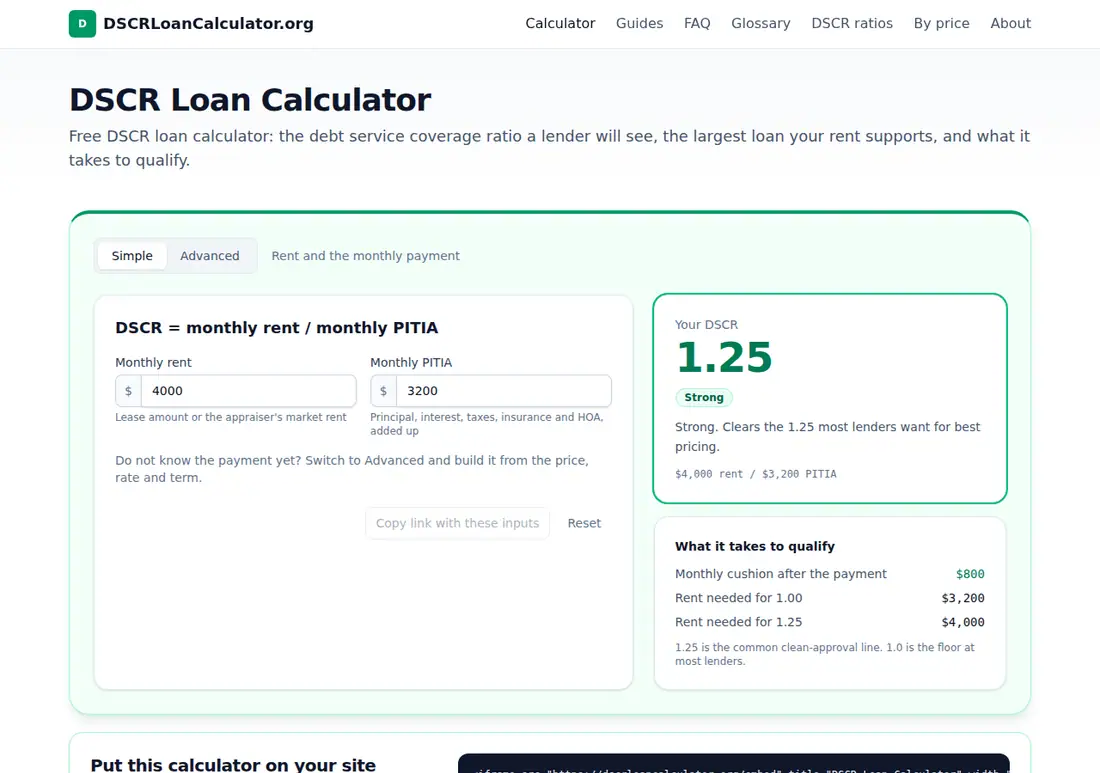
Price the deal twice: once at the rate your current band earns, once at the rate one band up would earn. The DSCR Loan Calculator takes purchase price, rent, taxes, insurance and rate, then returns the payment and the ratio, so you can see which band actually clears your lender’s minimum. Run your own numbers in the DSCR loan calculator.
Frequently asked questions
What credit score do you need for a DSCR loan?
Most DSCR lenders set the floor at 620, some at 640 or 660, and a few go down to 600. Pricing improves in bands of roughly 20 points, and the best rates plus the 80% LTV tier usually go to borrowers at 720 or higher. Because these are non-agency loans, every lender writes its own grid, so the same score prices differently from desk to desk.
Can you get a DSCR loan with bad credit?
It depends what bad means. In the 620 to 659 range many lenders still quote, with a lower LTV cap, larger reserves and a rate adjustment. Recent mortgage lates, a bankruptcy in the last two to four years, or a recent foreclosure are usually hard stops whatever the score says. Below 620 the 30 year market mostly closes and bridge or hard money takes over.
Can I get a DSCR loan with a 580 credit score?
Rarely as a 30 year DSCR loan. Almost every program floors out between 600 and 620, so a 580 score points you toward short term investor financing instead: bridge or hard money, often 12 to 24 months, with points up front. Investors use that to buy time, repair the score, then refinance into a DSCR loan once they clear the minimum.
Is there a DSCR loan with no minimum credit score?
That phrase usually describes foreign national programs for borrowers with no US credit file at all. Those substitute foreign bureau reports, bank reference letters or a bigger down payment for a FICO score. It is not a waiver for a US borrower with damaged credit. No-ratio programs are a separate thing: they skip the rent test, not the credit test.
Is a 660 credit score enough for a DSCR loan?
Yes at most lenders, though not at the best terms. A 660 file typically caps near 75% LTV on a purchase, carries a rate adjustment against the 720 and 740 bands, and may need six months of reserves rather than three. A clean payment history at 660 often underwrites more smoothly than a higher score with a recent mortgage late behind it.