DSCR Loan Term Options: 30-Year Fixed, ARM, 40-Year, and Balloon
DSCR loan terms compared: 30-year fixed, 5/1 and 7/1 ARMs, 40-year, and short balloon notes, plus what each structure does to your payment and your ratio.
By the DSCRLoanCalculator.org team
DSCR loan terms are a short list. Most lenders quote a 30-year fixed, a 5/1 or 7/1 ARM, a 40-year version of the fixed loan, and on short-term money, a balloon note due in five to seven years. A DSCR loan at 15 years exists at a few lenders, but almost nobody takes one, for a reason the arithmetic makes obvious further down. Term length matters more on this product than on a loan against the house you live in, because the term sets the payment, and the payment sets the ratio your approval rests on.
That is the core of how a DSCR loan works. The lender divides rent by the full monthly payment, and the term is one of the few parts of that payment you actually get to pick.
Every example here uses the same property: a $500,000 rental that rents for $4,000 a month, with $6,000 a year of property taxes and $2,500 of insurance. That is $708 a month of escrows. At 75% loan to value the loan is $375,000. On a 30-year fixed at 7.5%, principal and interest come to $2,622, so PITIA is $3,330 and the DSCR is about 1.20. Rates move with the market, so treat 7.5% as a round example rate rather than a quote.
The 30-year fixed, and why most investors start there
The 30-year fixed-rate mortgage is the default on nearly every DSCR term sheet. The rate is set at closing and never moves, which means the ratio the underwriter approved is close to the ratio you will still have in year eight. Only taxes and insurance drift.
That predictability is the product’s main appeal to buy and hold investors. You are financing an asset you plan to keep, with a payment you can forecast. The cost is a slower payoff and a rate that is usually a little above the shorter and adjustable options at the same lender.
5/1 and 7/1 ARMs: lower start rate, later reset
An adjustable-rate mortgage is fixed for an opening stretch, then resets on a schedule. A 5/1 ARM is fixed for five years and then adjusts once a year, usually to an index such as SOFR plus a fixed margin, inside the caps written in your note. A 7/1 gives you seven years first.
The pitch is a lower start rate, and lenders underwrite the ratio on that start rate. Take the same $375,000 loan half a point cheaper at 7.0%. Principal and interest drop to about $2,495, PITIA is roughly $3,203, and the DSCR comes in near 1.25 instead of 1.20. That is enough to move a file into a better pricing tier at many lenders.
The reset is the part to price in before you sign. After five years the balance is around $353,000. If the rate lands at 9.5% and the remaining balance amortizes over 25 years, principal and interest rise to about $3,084, PITIA to roughly $3,792, and the ratio falls to about 1.05. The discount on the start rate is not always there either. When short and long rates sit close together, an ARM can price no better than the fixed. Ask for the index, the margin, and every cap, then run the worst allowed reset through the math yourself.
40-year terms and what the extra decade buys
Stretch the same $375,000 at 7.5% over 480 months and principal and interest fall to about $2,468. PITIA becomes roughly $3,176 and the DSCR rises to about 1.26. That is roughly $154 a month of payment relief and six points of ratio, bought without changing the rate or the down payment.
What you give up shows on the amortization schedule. In the early years almost all of the payment is interest, and the 40-year schedule makes that worse, so equity builds mostly through rent growth and appreciation rather than paydown. Many 40-year DSCR programs are also structured as a 10-year interest-only period followed by a 30-year amortizing stretch, and pricing often sits slightly above the plain 30-year fixed. Use the long term when the ratio needs help, not as a default.
Short balloon terms and the refinance you are signing up for
On a balloon payment mortgage the monthly payment is usually calculated on a 30-year schedule, but the full remaining balance is due in five or seven years. Because the payment matches the 30-year payment, the ratio looks identical at closing. Our example still reads 1.20.
The risk is not in the payment, it is in the deadline. You are committing to sell, refinance, or pay off the balance on a date set years before you know what rates, rents, or appraised values will look like. Balloon terms are common on bridge money and on loans against properties that need work. They are a poor fit for a stabilized rental you intend to keep, unless the exit is already planned.
What 15 years does to the ratio
Take the same loan over 180 months at 7.5%. Principal and interest jump to about $3,476, PITIA hits roughly $4,184, and the DSCR drops to about 0.96. That is below 1.0, which fails the minimum on most programs. The property has not changed and the rent has not changed. Only the term did.
That is why short amortization is rare on loans qualified by rent. The faster payoff that makes a 15-year attractive on a primary residence is the same thing that breaks the ratio here.
Matching the term to how long you plan to hold
Start with the hold period, then pick the structure.
- Holding ten years or more: the 30-year fixed, because a reset you cannot predict is a bigger problem than a slightly higher rate.
- Selling or refinancing inside five to seven years: an ARM or a balloon can be cheaper, as long as the exit is realistic.
- Ratio just under the lender’s minimum: the 40-year or an interest-only period, before you consider a larger down payment.
One more item belongs in this decision. Check whether the loan carries a prepayment penalty and how long it lasts. A five-year step-down penalty on a property you plan to flip in two years can cost more than any rate difference between the terms on your sheet.
Run your own terms
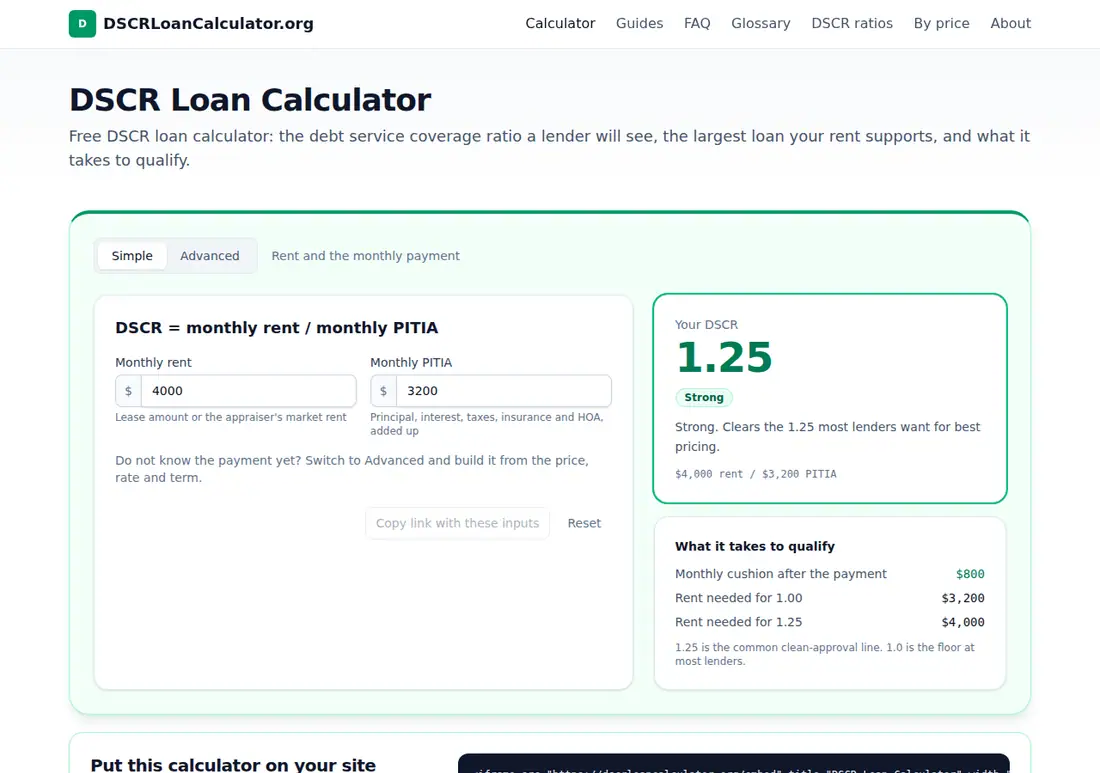
The DSCR Loan Calculator on the home page takes the loan amount, rate, and term, so you can price a 30-year against a 40-year or an ARM reset and watch the ratio move. The simple tab skips the loan details when you already have a payment quoted: $4,000 of rent against a $3,200 PITIA payment is a DSCR of 1.25.
Frequently asked questions
What loan terms do DSCR lenders offer?
Most DSCR lenders quote a 30-year fixed, a 5/1 or 7/1 adjustable rate loan, and a 40-year option that is often paired with a 10-year interest-only period. Short-term and bridge programs use balloon notes due in five to seven years. A 15-year term exists at some lenders but is rarely used on rentals.
Can you get a 30-year fixed DSCR loan?
Yes. The 30-year fixed is the standard DSCR structure and the one most lenders price as their baseline. The rate and the principal and interest portion of the payment never change, so the ratio the lender approved stays close to the ratio you live with for the whole hold, apart from tax and insurance increases.
Is there a 40-year DSCR loan?
Many DSCR lenders offer one. Stretching the same loan over 480 months instead of 360 lowers the monthly payment and raises the ratio, which can rescue a deal that lands just under the lender's minimum. The trade is slower principal paydown and, at many lenders, slightly higher pricing than the 30-year fixed.
How does an ARM change your DSCR?
An adjustable rate loan is underwritten on its start rate, so a lower start rate produces a higher ratio on day one. After the fixed period ends, the rate resets to an index plus a margin, within the caps in your note. A reset of two points can pull a 1.25 ratio down near 1.05.
Can you get a 15-year DSCR loan?
A few lenders will write one, but the payment usually breaks the ratio. On a $375,000 loan the 15-year principal and interest payment runs several hundred dollars a month above the 30-year payment, which is often enough to push the DSCR under 1.0. Lenders that qualify on rent rarely have a program that accepts it.