DSCR Loan Pros and Cons: What You Gain and What It Costs
DSCR loan pros and cons weighed side by side: what rent-qualified financing gives you, what the rate premium and penalties cost, and when to borrow another way.
By the DSCRLoanCalculator.org team
DSCR loan pros and cons come down to one trade: you qualify on the property’s rent instead of your personal income, and you pay for that with a higher rate, a larger down payment and usually a prepayment penalty. A DSCR loan is a good idea when the rent clears the payment with room to spare and your tax returns would sink a conventional application. It is a bad idea when the ratio sits barely above 1.00, because every extra cost lands on a property with nothing spare.

Both sides below run through the same property: a $500,000 rental renting for $4,000 a month, with $6,000 a year of property taxes and $2,500 of insurance. That file comes out near a 1.20 debt service coverage ratio on the default loan, with a payment around $3,330 a month.
What a DSCR loan gives you that a conventional loan does not
- No tax returns, W-2s or pay stubs. Underwriting reads the lease, the appraisal and the rent schedule. A self-employed investor with heavy write-offs gets the same terms as a salaried one. These sit in the same family as a no doc loan, even though the property itself is documented in full.
- No debt-to-income test. Your other mortgages do not count against you except in the reserve requirement.
- No limit on financed properties. Conventional financing closes at ten. DSCR lenders do not count.
- Title in an LLC from the start, with the members signing personal guarantees.
- Faster closings, often 21 to 35 days, because there is no income review to stall.
- Interest-only payments at many lenders, which lifts the ratio on a deal that would otherwise fail.
- Short-term rentals, condos and small multifamily that conventional underwriting treats as problems.
One legal point sits under all of this. A DSCR loan is business purpose credit, not a consumer mortgage, so it falls outside the ability-to-repay rules written under the Dodd-Frank Act. That is why nobody asks what you earn. It is also why you cannot live in the property.
The costs: rate spread, points, down payment and penalties
The rate premium
Expect roughly 0.75 to 2 points above a comparable conventional investment loan. Where you land depends on your ratio, your credit score, your loan to value and the market on the day you lock, so treat any single advertised figure as stale.
The money is real. On a $375,000 loan, one point of rate is about $260 a month, or $3,100 a year. Hold five years and that one point costs about $15,700. The full comparison is in DSCR against a conventional investment loan.
Cash in and fees
Twenty to 25% down is typical, so $100,000 to $125,000 on the example above. Origination runs 1 to 2 points where conventional runs 0 to 1. Lenders also want 3 to 6 months of payments in reserve, which on a $3,330 payment means $10,000 to $20,000 sitting idle.
Prepayment penalties
Most DSCR loans carry a prepayment penalty for three to five years, either flat or stepping down each year. The usual cost is 2 to 5% of the balance. On a $375,000 balance, a 3% penalty is $11,250 owed if you sell or refinance early.
Some lenders will remove it for 0.25 to 1 point more rate. That choice is a straight bet on how long you hold. The rest of the tradeoffs are collected in the downside of a DSCR loan.
Where the loan quietly fails
Every advantage above assumes cash flow. Take the cash flow away and the same structure works against you.
Thin ratios price badly and break easily. Push the payment on the example from $3,330 to $3,640, which a higher rate alone can do, and the ratio drops from 1.20 to 1.10. At a $4,000 payment it is 1.00, where pricing gets steep and some programs stop taking the file. What counts as a good DSCR covers where those cutoffs usually sit.
Taxes and insurance live inside the payment. If insurance renews at $5,000 instead of $2,500, the payment rises about $208 a month and the ratio falls to roughly 1.13. You did nothing, and your position got worse.
The ratio also hides vacancy. It compares one month of rent to one month of payment. Two vacant months at $4,000 is $8,000 gone, and the 1.20 on your approval letter never mentioned the risk.
Weak markets combine all three. Where rents are flat and turnover is high, the rate premium never gets earned back by rent growth, and the penalty blocks the exit.
Who a DSCR loan actually suits
- Self-employed investors whose returns understate what they really earn.
- Anyone past the ten property conventional limit.
- Investors who want LLC title and liability separation from the first day.
- Buyers on a short clock who cannot wait for a full income review.
- Owners of strong cash flow property at 1.25 and up, where the premium is smallest and the ratio earns the best pricing.
- Short-term rental owners with a documented income history.
Who should borrow another way instead
- A W-2 borrower with room in the debt-to-income ratio and fewer than ten properties. Conventional is cheaper. Use it while the door is open.
- A flipper. You want a hard money loan or a bridge loan, not thirty year financing with a penalty attached.
- Anyone planning to sell or refinance inside two years, unless the penalty gets bought out up front.
- Anyone who wants to live in the property. Occupancy is not permitted on these loans.
- A borrower whose ratio is under 1.00 at current rent. Raise the rent, raise the down payment, or wait. What is better than a DSCR loan runs through the alternatives.
Questions to answer before you apply
- What is the ratio at the rate you were quoted today, not the rate you hope to get?
- What does the ratio look like if insurance renews 50% higher?
- How long is the prepayment penalty, and what does buying it out cost in rate?
- Is the income a signed lease or the appraiser’s market rent, and which one will the lender use?
- How many months of reserves are required, and is that cash you can leave untouched?
- Would a conventional loan still approve you, and what is the gap in dollars per year?
If the first two have no answer yet, you are not ready to lock.
Weigh it with your own numbers
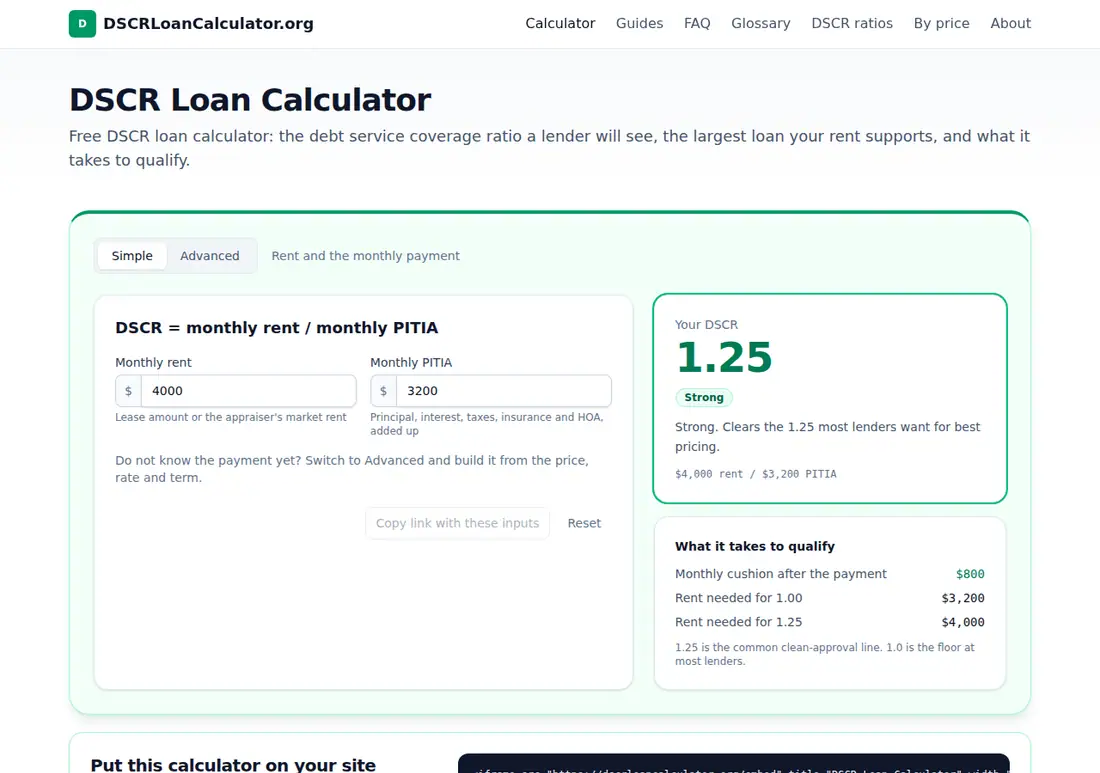
The pros and cons only resolve once you see the ratio. Put the rent, the taxes, the insurance and your quoted rate into the DSCR Loan Calculator, then run it again with a higher rate and a higher insurance bill. If the deal still clears, the premium is probably worth paying. If it does not, you have your answer.

Frequently asked questions
Are DSCR loans a good idea?
A DSCR loan is a good idea when the property's rent covers the payment with room to spare and your tax returns would sink a conventional application. It is a poor idea when the ratio sits near 1.00, because the higher rate, the larger down payment and the prepayment penalty all land on a property with no cushion to absorb them.
What are the main benefits of a DSCR loan?
No tax returns, W-2s or pay stubs. No debt-to-income test, so your other mortgages do not block you. No cap on financed properties, where conventional financing stops at ten. Title can close in an LLC from day one. Closings often run 21 to 35 days, and interest-only payments are widely available, which raises the qualifying ratio.
What is the biggest drawback of a DSCR loan?
Cost, and the prepayment penalty that locks it in. Rates typically run about 0.75 to 2 points above a comparable conventional investment loan, with the exact spread set by your ratio, credit score and loan to value. Most DSCR loans then add a three to five year penalty of roughly 2 to 5% of the balance if you sell or refinance early.
Should I get a DSCR loan or a conventional loan?
Use conventional while you qualify for it, since it is cheaper and carries no prepayment penalty. Switch to a DSCR loan when the conventional door closes: self-employment write-offs that hide your income, more than ten financed properties, LLC title, a short-term rental with no history, or a closing date too tight for a full income review.
Is a DSCR loan still worth it if my ratio is barely above 1.00?
Usually not. A ratio near 1.00 prices at the worst end of the range, so you pay the largest premium on the property least able to carry it. One insurance renewal or one vacant month puts the deal under water. Raising the down payment, adding an interest-only period or waiting for higher rent all beat borrowing at that level.